Why the yield of a photovoltaic system is never constant
The output of a PV system does not remain unchanged over time. Even when the installed power is correct, the amount of energy produced can vary depending on operating conditions, the condition of components, and the use of the system.
This difference between rated power and actual output is related to a number of factors that affect progressively: changes in the environment, wear and tear on components, changes in energy loads, and changes in the way people use them.
The result is a loss of yield that is often not perceived immediately, but over time leads to lower than expected production.
Identify and resolve the causes that reduce yield
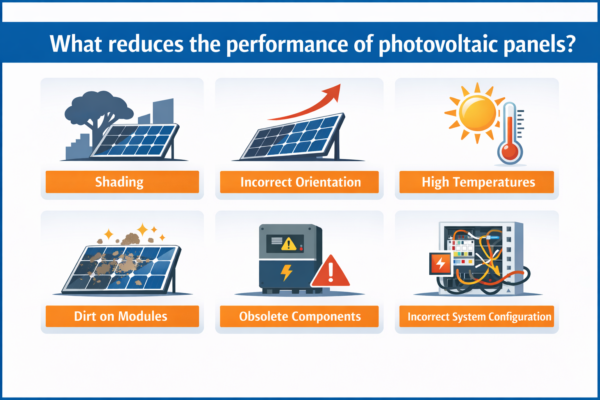
Increasing the output of a system starts with identifying where energy is being lost. Losses usually depend on several factors acting simultaneously on the system.
- Even partial shading, which reduces the output of the entire string
- Non-optimal orientation and tilt, limiting useful irradiance
- High temperatures, which lower the efficiency of the modules
- Dirt and deposits on the panels, which reduce the ability to capture light
- Components that are no longer performing, such as inverters or dated modules
- Non-optimized electrical configurations, with imbalances between strings
The overall performance depends on how they interact with each other, so technical analysis is the first step in defining effective interventions.
How to increase the yield of photovoltaic panels in 5 steps
Once the causes are identified, targeted action can be taken. The goal is to improve production without unnecessarily intervening in the entire plant.
1) Cleaning and maintenance of modules
The presence of dust, residue or surface deposits reduces the amount of light reaching photovoltaic cells. In industrial or agricultural settings this effect is more noticeable and can significantly affect production.
Regular maintenance helps maintain consistent performance and avoid progressive declines by scheduling checks and interventions according to operating conditions.
2) Performance control and monitoring
Monitoring allows actual production to be compared with expected production. When deviations emerge, anomalies, failures or inefficiencies are quickly identified.
A continuous monitoring system allows intervention before yield loss becomes significant, keeping the plant aligned with expected performance.
3) Optimization of plant configuration.
Electrical configuration affects the distribution of output. Imbalances between strings, suboptimal connections, or outdated configurations can reduce overall efficiency.
Intervening here can improve yield without changing the entire system, but by acting on the parts that directly affect energy flow.
4) Component upgrade
Over time, some components become less efficient than available technologies. Inverters and modules can limit production even if they are still functioning.
In these cases, selective upgrading of critical parts allows overall performance to be improved by revamping or retrofitting PV systems allow less performing components to be replaced without intervening on the entire structure.
5) Increase in installed power
When the system is working properly but production is no longer sufficient compared to consumption, action can be taken by increasing the installed power. This type of intervention mainly concerns existing plants where the area is already used but can be optimized with more efficient technologies.
The use of higher-performance modules allows more energy to be produced for the same amount of space, thus increasing production without changing the overall configuration of the plant.
Mistakes that reduce plant performance
In addition to technical factors, there are recurring conditions that lead to loss of production over time. These are often situations related to the management of the plant rather than its initial design.
- Absence of performance monitoring
- Unscheduled or absent maintenance
- Shadows not detected or changed over time
- Components out of date with respect to operating conditions
- Configuration not appropriate for actual plant use
These elements, if unmanaged, progressively reduce yield and make it more difficult to identify the causes of production loss.
When to intervene to increase yield
Yield loss is not always evident; in many cases it only emerges by comparing data over time or analyzing consumption versus production.
- Lower production than originally expected
- Plant installed several years ago
- Increased consumption for the same plant
- Recurrent abnormalities or drops in production
- Changes in operating or environmental conditions
In these situations, it is useful to conduct a technical audit to understand where to intervene and what actions can improve performance.
If you suspect a drop in performance, then start by comparing consumption and data over time.
Increase yield without redoing the system
Many interventions can be performed without completely replacing the plant, as we anticipated earlier when discussing revamping and retroffing. Upgrading components, correcting configurations, and integrating control systems can achieve significant improvements by taking targeted action.
With such an approach you will be able to reduce costs and maintain business continuity, intervening only where necessary and without changing the entire plant structure.
Control production over time after yield increase
The performance of a system does not depend only on the initial interventions, or even the later ones when you want to improve it. Instead, it depends on the ability to maintain its performance over time. Monitoring, maintenance and periodic checks should never be forgotten as they allow you to quickly detect any declines and intervene before they become significant.
Intervening on yield with technical analysis
Each plant has specific conditions, we know. The causes of yield loss are not the same for all and require technical evaluation to be accurately identified.
Intervening without analysis often leads to limited results; conversely, identifying critical issues allows for targeted interventions and concrete improvements in production.
If you want to understand how to increase the yield of your PV system, requesting a technical assessment is the first step in identifying the most suitable solutions.