Firefighting course “level 3” or high risk, in companies
When is the high risk firefighting course mandatory?
In Italy, fire safety training is mandatory when the activity has a high level of fire risk. The regulatory reference is the Legislative Decree. 81/2008 together with the Ministerial Decree of September 2, 2021, which defines the management criteria for fire safety in workplaces.
Many companies still speak of “high risk,” but at the regulatory level the updated classification refers to Level 3. These are those activities where the likelihood of fire or potential consequences require structured emergency management.
This level includes, for example, environments with the presence of flammable materials, complex workmanship or conditions that make evacuation and control of a fire start more difficult.
| Type of activity | Operating conditions | Mandatory course level 3 |
|---|---|---|
| Companies with high fire risk | Presence of flammable materials, complex processes, high fire load | Mandatory |
| Activities with evacuation difficulties | High turnout, articulated environments or presence of non-autonomous people | Mandatory |
| Complex manufacturing facilities | Industrial processing with potential triggers or rapid propagation | Mandatory |
| Activities with non-high fire risk | Simple operating conditions, low fire load | Not required (level 1 or 2) |
Who should take the course
The course is intended for firefighters, figures appointed by the employer to manage emergencies within the company. Appointment is not optional: each organization must identify an appropriate number of people based on size, shifts and characteristics of the business.
Incumbents must be trained before assuming the role. Training is needed to enable rapid and organized intervention in the early stages of an emergency, when internal management can make a difference.
What does the high risk firefighting course involve
The training combines theoretical content and practical activities. The goal is to provide skills that can be used in real situations, not just general knowledge.
- Principles of combustion and fire dynamics
- Activity-specific risk assessment
- Prevention and protection measures
- Emergency procedures and evacuation
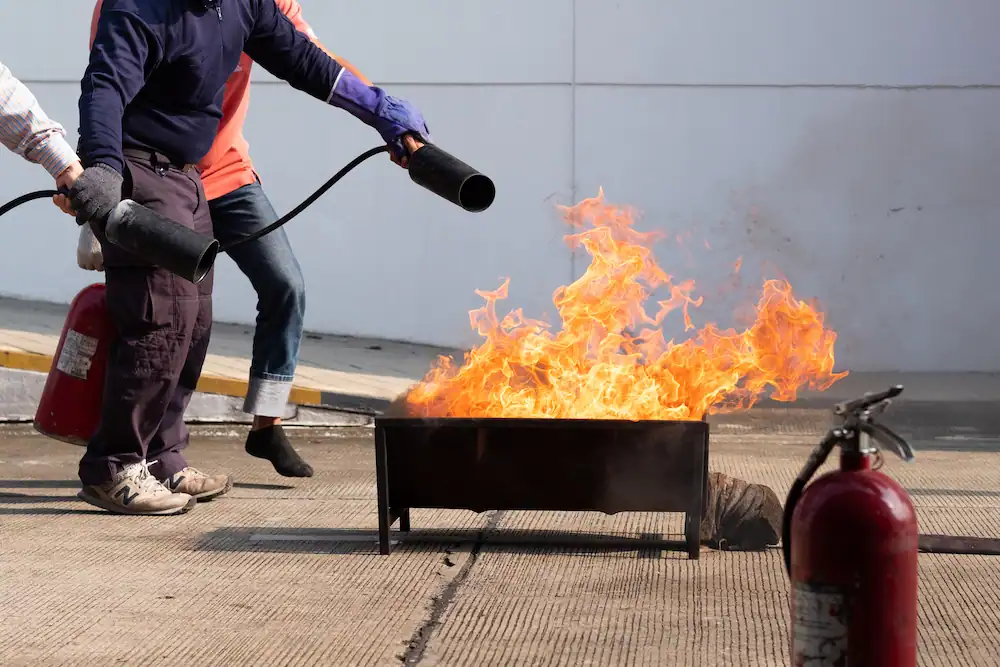
- Practical use of fire extinguishers and firefighting equipment
The practical part is compulsory and is carried out with actual tests; this step allows workers to become familiar with the equipment and how to operate it.
Course length and updates
For activities classified as Level 3, the duration of the course is defined in the regulations.
- Initial duration: 16 hours
- Mandatory updating: every 5 years
- Duration of update: 8 hours
Updating, moreover, is necessary to keep skills valid over time. Changes in business processes or operating conditions make periodic alignment of training essential.
For whom the level 3 firefighting course is mandatory
The course is mandatory for workers assigned by the employer to handle fire prevention, firefighting and emergencies. The Ministerial Decree of September 2, 2021 stipulates that these employees must receive specific training and periodic updates, with minimum contents defined in Annex III.
| Corporate figure | When the obligation is triggered | Required training |
|---|---|---|
| Appointed firefighting officers | When the employer formally assigns the task of managing the fire emergency | Firefighting course appropriate to the risk level of the activity |
| Employees of companies with high-risk activities | When the workplace falls under the conditions that require level 3 training | Level 3 course with theoretical and practical part |
| Non-designated workers | If not designated as firefighters | Not firefighter course, but information and instruction consistent with the emergency plan |
This point is important because the obligation does not affect all employees equally; it concerns people who, in the event of a fire start or evacuation, must act according to precise procedures and with dedicated equipment.
What happens if the course is not conducted
When appointed employees do not receive the required training, the company exposes itself to incomplete emergency management and noncompliance with the employer’s obligations. The decree explicitly requires both initial training and updates at least every five years.
Indeed, in a real-world situation, untrained personnel may find themselves handling evacuation, fire extinguisher use and first containment measures without having sufficient preparation. This is why firefighting training has operational value before it has regulatory value.
Theoretical education and practical training
In Level 3, the practical part carries decisive weight. It is not enough to know procedures and risk classifications: employees must know how to recognize a hazardous situation, correctly activate the internal response and use equipment appropriately. The Fire Department expressly recalls the educational support for corporate firefighting training and education courses pursuant to Legislative Decree 81/08 and Ministerial Decree Sept. 2, 2021.
This directly affects the company’s ability to manage the first few minutes of an emergency, and a well-structured course serves precisely to link procedures, roles and concrete actions.
When to schedule the course or update
The course should be organized when new firefighters are appointed or when the business activity changes and requires different fire risk management. Updates, on the other hand, must be scheduled on a regular basis: for level 3, the initial course duration is 16 hours, and the update is scheduled every 5 years for a duration of 8 hours.
Anticipating planning avoids tight deadlines, training gaps and organizational difficulties, especially in companies that work in shifts or have multiple operating locations.
The level 3 firefighting course in enterprise safety management
Fire safety training is part of the broader management of occupational safety. It should be read in conjunction with the risk assessment, emergency plan, internal organization and the presence of assigned figures, so course scheduling must be consistent with the structure of the company and the actual risk of the activity.
As part of an overall occupational safety service, firefighter training makes it possible to translate regulatory obligations into enforceable procedures, clear roles and orderly management of emergencies.
Properly organize the fire-fighting course in the company
To organize the course properly, one must start with three checks:
- Activity risk level,
- Number of staff to be appointed,
- Status of existing training.
From there, initial course, updates and training schedule are defined.
If your company operates in complex or high-risk fire settings, training should not be treated as an isolated requirement but should be considered as part of ongoing management, updated and consistent with the activity performed. If you need to verify obligations, deadlines or the most suitable training path, request a technical discussion to organize the training properly.