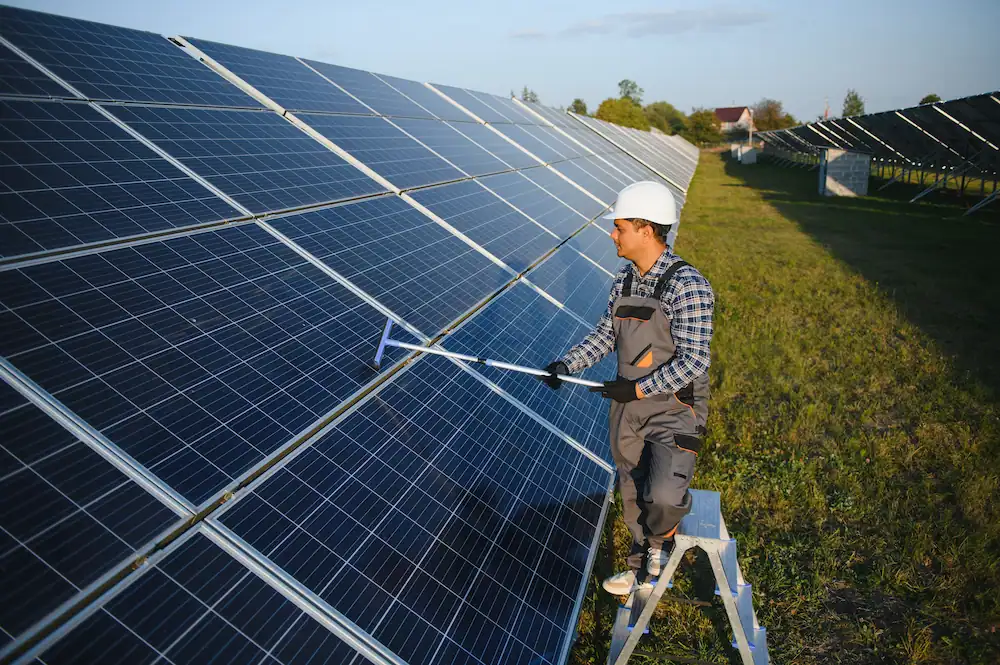
Routine maintenance of photovoltaic panels: how to maintain production and continuity of the system
Maintaining the performance of a plant over time
A PV system can only maintain stable production if it is operated over time. Even when components are functioning properly, environmental conditions, wear and tear, and operational variations affect overall performance.
The reduction in production does not happen suddenly, in most cases it is progressive: small deviations that, when added up over time, lead to a lower yield than expected.
Routine maintenance intervenes in precisely this aspect: it keeps the plant in proper operating condition, preventing inefficiencies and anomalies from accumulating into more complex problems.
What activities include routine maintenance of a photovoltaic system
Routine maintenance covers all scheduled activities that serve to maintain the proper functioning of the plant; recurring operations that allow the state of components and the quality of production to be checked.
| Activities | Intervention | Objective |
|---|---|---|
| Cleaning of modules | Removal of dust, debris and surface deposits | Maintaining solar collection capacity |
| Visual inspections | Verification of modules, support structures, and wiring harnesses | Detect obvious anomalies |
| Electrical inspection | Checking inverters, connections, and protection systems | Ensure operation and safety |
| Monitoring | Analyze production and performance data | Identify declines or abnormal behavior |
These activities are part of ongoing plant management and are integrated into Operation & Maintenance services, which keep performance, safety, and business continuity under control.
Routine, preventive, corrective and improvement maintenance
Routine maintenance consists of interventions with different functions that work together to keep the system running efficiently. Let’s look at them together.
- Preventive maintenance; covers scheduled checks and periodic inspections. It is used to detect signs of wear or conditions that may lead to failure over time.
- Corrective maintenance; intervenes when anomalies emerge during controls or from monitoring. In this case, limited problems are acted upon before they significantly affect production.
- Improvement maintenance; on the other hand, concerns interventions aimed at optimizing performance. It may include adjustments, configuration upgrades, or integration of more effective control systems.
These activities are part of technical management to keep the plant aligned with actual operating conditions.
What is the difference between routine and extraordinary maintenance?
Distinguishing between routine and extraordinary maintenance provides insight into how a facility is managed over time and when more structured action is needed.
| Maintenance type | Interventions | When to apply |
|---|---|---|
| Ordinary | Cleaning, controls, monitoring | Periodic plant management |
| Extraordinary | Replacement of components, technical changes | Failures or upgrades |
Routine maintenance involves scheduled and recurring activities; it is used to keep the system in proper operating condition, verifying that all components are working as intended. At this stage, action is not taken to modify the system, but to check, prevent, and maintain.
Extraordinary maintenance, on the other hand, comes into play when something is no longer working properly or when the system needs to be upgraded. Operations such as replacing inverters, repairing faults, upgrading components, or changes to the plant configuration fall into this category.
The main difference is not only in the type of intervention, but in when it occurs. Routine management is continuous and planned, while extraordinary management is related to specific events or update needs.
A regularly followed plant reduces the likelihood of extraordinary interventions, while constant monitoring and periodic checks allow anomalies to be detected at an early stage, preventing them from developing into more complex and costly failures.
For this reason, routine maintenance is the basis on which the stability of the system is built over time.
How often to do photovoltaic panel maintenance
The frequency of maintenance is not the same for all facilities but depends on the conditions under which it operates and the level of exposure to external factors that may affect performance.
In industrial or agricultural settings, where more aggressive dust, debris or weathering is present, module cleaning and inspections should be more frequent. In less exposed environments, interventions can be scheduled with a more extended periodicity, while still maintaining regular checks.
In addition to cleaning, it is important to establish a schedule of technical checks and performance monitoring. Continuity of interventions is more relevant than isolated frequency: a plant followed over time maintains more stable performance than one that is managed occasionally.
How often to do photovoltaic panel maintenance
The frequency of maintenance is not the same for all facilities but depends on the conditions under which it operates and the level of exposure to external factors that may affect performance.
In industrial or agricultural settings, where more aggressive dust, debris or weathering is present, module cleaning and inspections should be more frequent. In less exposed environments, interventions can be scheduled with a more extended periodicity, while still maintaining regular checks.
In addition to cleaning, it is important to establish a schedule of technical checks and performance monitoring. Continuity of interventions is more relevant than isolated frequency: a plant followed over time maintains more stable performance than one that is managed occasionally.
Example of maintenance schedule in industrial or agricultural environment
| Frequency | Activity | Objective |
|---|---|---|
| Monthly | Monitoring production and checking for anomalies | Detect drops in yield or malfunctions |
| Quarterly | Visual inspection of modules, structures, and wiring | Detect obvious damage, wear, or criticality |
| Semiannually | Module cleaning (more frequent in highly exposed environments) | Maintain solar collection efficiency |
| Annual | Complete electrical verification and inverter checks | Ensure safety and proper operation |
| Continuous | Remote monitoring and performance analysis | Maintain constant control of the plant |
The schedule structure may vary depending on the type of plant and environmental conditions, as we anticipated. In agricultural settings with a high presence of dust or debris, cleaning may be needed more frequently. In industrial settings, on the other hand, the focus is often on continuous monitoring and control of electrical components.
What happens without routine maintenance?
An unmaintained plant tends to lose efficiency over time. The reduction in output is not immediate, but progressive, and is often detected only when the decline becomes evident.
- Reduction of energy production
- Dirt accumulation and loss of module efficiency
- Undetected anomalies on inverters and electrical components
- Increased risk of sudden failure
- Reduction in the useful life of the plant
These conditions directly affect business continuity and return on investment. By intervening in a planned manner, it is possible to avoid accumulations of critical issues that are difficult to manage over time.
Regulatory changes and their impact on maintenance
In recent years, the regulatory framework has significantly simplified the construction of photovoltaic systems. Measures related to the so-called Energy Decree (Decree Law 17/2022 and subsequent updates) have extended the cases in which installation falls underfree construction, making it possible to build systems without complex permits, especially on existing buildings and their appurtenances.
This simplification affects the installation phase, but it also has a direct effect on subsequent management. An increasing number of installations are being built quickly and without articulated permitting processes, increasing the need for structured technical management over time.
For routine maintenance, this involves a change in approach. It is not enough to intervene only when there are problems: it is necessary to keep the system under control, to check performance, and to ensure that it continues to operate under the intended conditions.
The technical directions of the IEC standards, along with the general obligations of the Legislative Decree. 81/2008, require that facilities be maintained in a safe and efficient condition. This translates into activities such as:
- Continuous monitoring of production
- Documented periodic audits
- Control of safety devices
- Recording of interventions carried out
Routine maintenance thus becomes an integral part of plant management. Regulatory simplification during installation makes continuous technical management, capable of ensuring performance, safety and operational continuity over time, even more important.
Managing maintenance without losing control over the plant
An unmanaged plant tends to lose efficiency and generate critical issues that are difficult to predict. In contrast, planned maintenance allows you to maintain control over performance and operating conditions.
The difference is not in the quantity of interventions, but in their continuity and consistency.
Knowing when to intervene, what to check, and how to monitor the system allows you to avoid problems and maintain stable results over time.
If you need to arrange maintenance for your PV system, contact us for an assessment and we will devise a plan consistent with your operating conditions and production goals.