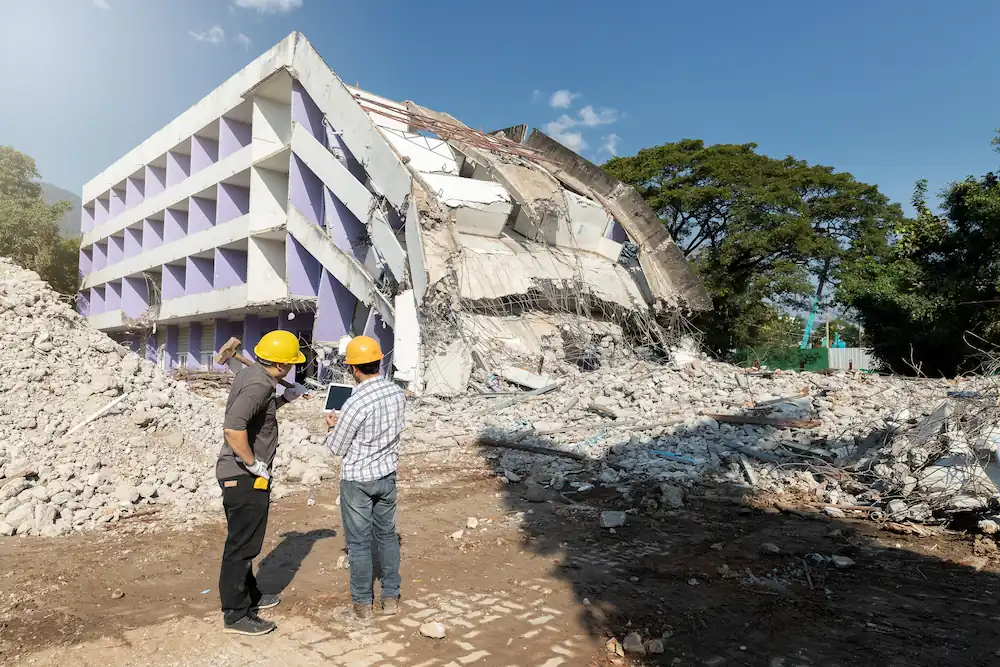
Where we start with earthquake retrofits for existing buildings
When to take action on the seismic safety of a building
Many existing buildings have not been designed according to current seismic standards. This means that, in the event of a seismic event, their behavior may not be adequate to the standards required today.
Critical issues are not always obvious; in some cases they emerge during technical inspections, in others they are related to changes over time: elevations, changes of use, or interventions that have altered the original structure.
Often it is not just about damaged buildings, but prevention: identifying weak points and improving the structure’s ability to withstand stress.
There are three macro areas of seismic upgrading interventions that can be worked on: local interventions on structural elements, seismic improvement interventions, and seismic retrofitting interventions.
1. Local interventions on structural elements
Local interventions concern specific parts of the building, do not change the overall behavior of the structure, but allow to solve punctual criticalities that may compromise stability in the event of an earthquake.
Interventions on masonry and walls
Masonry may have discontinuities, degraded materials or poor cohesion. In these cases, targeted consolidation techniques are used.
- Mortar injections to improve internal compactness
- Ristilation of joints to increase strength
- Localized reinforcements in the most stressed areas
These interventions make it possible to increase the resilience of the wall without changing the entire structural system.
Work on openings such as doors and windows
Openings are points of discontinuity in the structure. In the presence of earthquake, these areas can become critical areas.
- Hoops to distribute stresses
- Lintel reinforcement
- Improvement of structural continuity
The goal is to avoid stress concentrations that can lead to local cracking or failure.
Interventions on structural connections
A building responds best to stresses when the different elements are effectively connected to each other. In many existing buildings, these connections are weak or absent.
- Insertion of chains and tie rods
- Connections between walls and floors
- Securing of non-structural elements
By intervening on the connections, the overall behavior can be improved without operating on the whole structure.
2. Seismic improvement interventions.
Seismic upgrades increase the safety level of the building without necessarily bringing it up to the standards required for new construction. Action is taken on several structural elements, with the aim of reducing the overall vulnerability.
Interventions on masonry and load-bearing walls
When masonry has widespread criticality, interventions must be more extensive than local.
- Reinforcement with composite materials (FRP and FRCM)
- Widespread consolidation of walls
- Integration of reinforcing elements
These techniques improve the structure’s ability to absorb stress and reduce the risk of brittle fractures.
Interventions on floors and force distribution
Attics play a key role in the distribution of horizontal forces. If they do not work properly, the building reacts unevenly.
- Stiffening of attics
- Improved diaphragmatic behavior
- Effective connection between floors and walls
Proper floor behavior allows stresses to be distributed more evenly throughout the structure.
Roof and roofing work
Roofing directly affects the stability of the building, especially the masses and connections.
- Lightening the cover
- Improved connections with the underlying structure
- Reduction of unnecessary loads
By intervening on the roof, overall stresses can be reduced and the behavior of the building during a seismic event can be improved.
3. Seismic upgrades.
Seismic retrofitting interventions change the behavior of the building in a more incisive way. The goal is to bring the structure to a level of safety that meets current regulatory standards by intervening on the entire structural system.
Comprehensive structural interventions
In these cases, action is taken on the overall response of the building to seismic stresses. This is a true revision of the structural behavior.
- Redistribution of stiffnesses to improve overall response
- Insertion of new structural elements
- Changing the building configuration
These interventions are typical when the structure has widespread criticality or when it needs to be adapted to new regulatory requirements.
Interventions on beams, columns and structural nodes
In reinforced concrete structures, beams, columns and nodes represent the most stressed points during a seismic event. Their behavior directly affects the stability of the building.
- Laminating the pillars to increase their strength
- Beam-to-column node reinforcement
- Increased bearing capacity of the elements
These interventions improve the ductility of the structure and reduce the risk of sudden collapse.
Interventions on foundations
Foundations transfer stresses to the ground. If they are inadequate, the entire building may be vulnerable even when the upper parts are worked on.
- Consolidation of existing foundations
- Improved ground support
- Insertion of seismic isolation systems
These are more complex interventions, but often necessary when significant improvement in structural behavior is desired.
Difference between local intervention, improvement and adjustment
The three categories of intervention meet different objectives; the choice depends on the condition of the building and the level of safety that is to be achieved.
| Intervention type | Scope | Objective | Impact on the building |
|---|---|---|---|
| Local | Specific elements | Correcting punctual critical issues | Limited |
| Improvement | Structure | Increase the level of security | Medium |
| Adaptation | Entire building | Achieving regulatory standards | High |
This distinction is important because it allows the intervention to be properly defined, avoiding solutions that are inconsistent with the state of the building.
When is seismic retrofitting required?
Seismic retrofitting is required in specific situations, defined by the Technical Standards for Construction. It does not apply to all buildings, but becomes mandatory when interventions are carried out that significantly alter the structure.
- Building elevations
- Structural extensions
- Change of use with increased loads
- Interventions that significantly affect the structure
In such cases, it is necessary to check the overall behavior and, if required, bring the building up to the required standards.
How to choose the most suitable earthquake retrofits
The choice of earthquake-resistant interventions starts with a technical analysis of the structure. There is no one-size-fits-all solution for all buildings; each intervention must be defined according to the critical issues found and the safety objectives.
Vulnerability assessment allows priorities to be identified and interventions to be planned consistently. In many cases, seismic interventions are integrated with broader energy and seismic upgrading activities so as to optimize time and work.
Improving safety with targeted interventions
Earthquake retrofits must be proportionate to the actual condition of the building. It is not always necessary to intervene on the entire structure: it is often possible to improve safety by acting on the main critical issues.
A preliminary assessment allows the most effective solutions to be identified, avoiding unnecessary interventions and ensuring real improvement in seismic behavior.