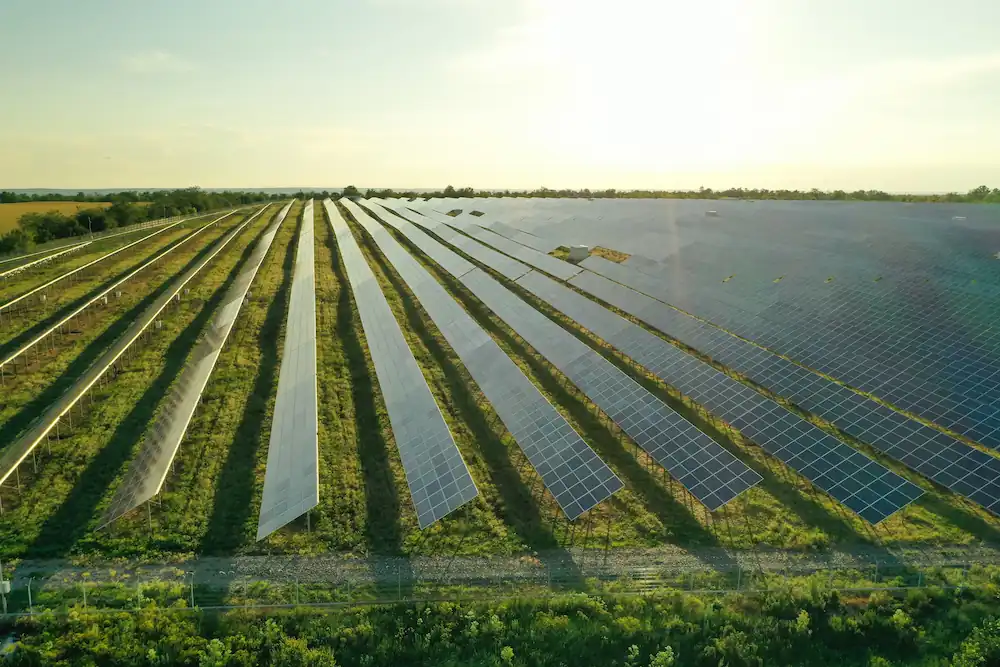
Photovoltaic systems on agricultural land between requirements, yield and actual limits
When it makes sense to use farmland for photovoltaics
A ground-mounted PV system arises from a different logic than one installed on buildings. Here the starting point is not consumption, but the availability of area and the possibility of transforming it into energy production.
This choice makes sense when:
- adequate coverage is not available;
- the land is not productively exploited;
- you want to generate energy for sale or income supplement;
- the surface area is sufficient to support a coherent planting.
Conversely, if the goal is to cover business consumption, the assessment changes and the relationship between energy production and use becomes central. In these cases, it is useful to first analyze PV applied to business consumption, because the sizing logic is different.
Where ground-mounted photovoltaic systems can be installed
Whether a plant can be installed depends mainly on urban planning, environmental and landscape constraints. Not all agricultural land is automatically suitable.
Generally favorable conditions
- Agricultural areas without significant landscape constraints;
- Areas with access to the power grid;
- Flat or gently sloping terrain;
- Absence of significant shading.
Where it is not possible or is limited
- Areas subject to landscape or environmental constraints;
- Agricultural areas with specific limitations in urban planning instruments;
- Protected or conservation areas;
- Land with uses incompatible with energy facilities.
This is one of the most critical points: feasibility is not automatic. An initial technical verification avoids building a project on land that cannot be used.
Need one? Contact us without obligation.
Technical requirements of a plot for photovoltaics
In addition to regulatory aspects, a land must meet certain technical conditions to support an efficient plant.
- Exposure: favorable orientation and no obstacles.
- Morphology: regular surfaces facilitate installation and maintenance.
- Accessibility: essential for work and management over time.
- Grid connection: distance and connection capacity affect costs.
- Available area: must be consistent with the installable power.
Large but difficult-to-connect land to the grid can significantly reduce the sustainability of the intervention.
How much energy does 1 hectare of photovoltaics produce?
The yield of a land is evaluated by connecting three elements: area, installed power and producibility.
| Parameter | Indicative value |
|---|---|
| Surface area | 1 hectare (10,000 m²) |
| Installed power | about 0.8 to 1 MW |
| Annual production | 1,200,000 to 1,500,000 kWh |
These values change according to:
- irradiance of the area;
- plant configuration;
- Distance between rows of modules;
- technical losses.
The important figure is not the absolute number, but the relationship: more usable area → more power → more energy produced.
How much do you make from a planting on farmland?
The bottom line depends on how the energy produced is used.
Sale of energy
- Energy price-related revenues;
- market dependence;
- Constant but time-varying income.
Direct energy use
- Reduction in energy cost;
- Greater control of spending;
- benefit related to self-consumption.
In the former case the land becomes a source of income, in the latter it becomes an operational support for the business. The choice completely changes the configuration of the facility.
How many kW are needed to be autonomous?
Again, there is no standard value. The power needed depends on:
- annual consumption;
- Distribution of loads throughout the day;
- Share of energy used directly.
For this reason, the assessment of autonomy does not start from the land, but from consumption. When the goal is a balance between production and use, it is necessary to analyze the company’s energy profile and the proper sizing of the plant.
Re-entry times of a ground system
Amortization time depends on three main variables:
- cost of the plant;
- energy produced;
- Value of energy (sold or saved).
Under standard conditions, the return on investment is in a range of 6 to 10 years, but the actual figure changes depending on the specific project.
An undersized plant or one installed on unsuitable ground can significantly lengthen these times, so always better not to improvise.
Mistakes to avoid when evaluating land
- Ignore regulatory constraints and proceed without prior verification.
- Estimating yield without technical site analysis.
- Use the land when there are available covers.
- Disregard network connection.
These errors directly affect the feasibility and economic viability of the project.
Properly evaluate a ground-mounted photovoltaic system
Farmland can become an energy resource, but only when constraints, technical characteristics and economic goals are aligned.
Therefore, the initial phase must connect:
- suitability of the site;
- installable power;
- expected production;
- Modes of energy use.
When these elements are analyzed together, it is possible to build a coherent and sustainable facility over time. Otherwise, the risk is to develop a project that does not meet the real objectives.
If you want to understand whether your land is suitable and what configuration can work, you can request a preliminary technical assessment based on real data and not on generic estimates.