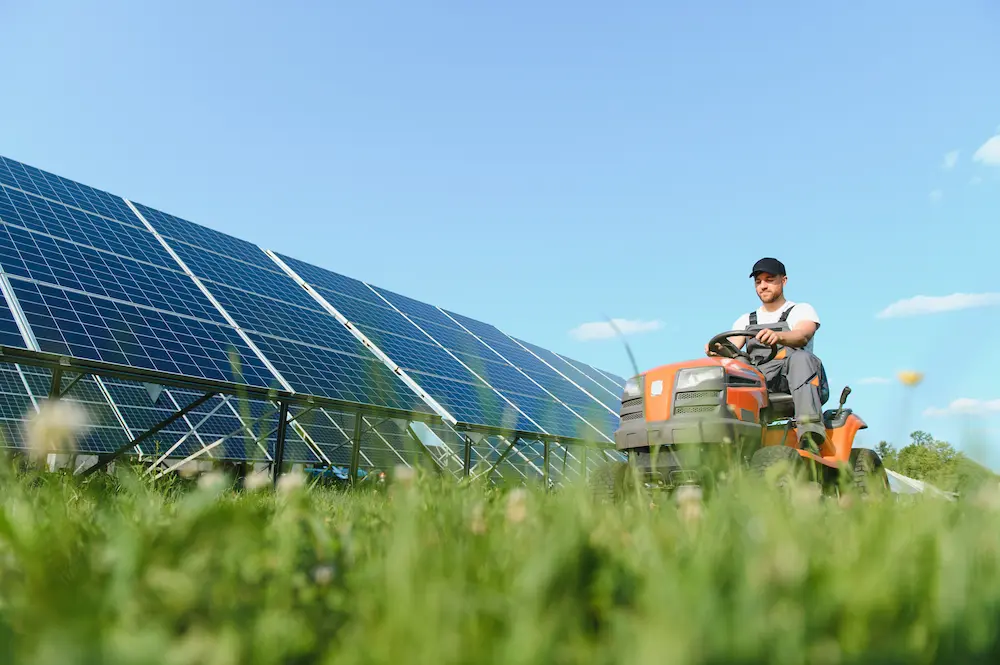
Photovoltaics for farms and energy management
Farms manage energy consumption related to irrigation, processing, conservation and facility use. These needs are not constant and require solutions capable of adapting to operational activities.
A photovoltaic system allows electricity to be produced directly on the farm and used during work phases, reducing reliance on the grid and affecting costs. The result depends on the relationship between consumption, available area and proper sizing.
Photovoltaics applied to farms then becomes part of the production system: not only installation, but also performance over time, management and optimization interventions.
Photovoltaics on farms
In agriculture, a photovoltaic system is used to support the electrical needs of buildings, equipment and processes that work continuously or in peak phases. The goal is to produce power near the point of use and reduce reliance on the grid during the hours when the farm consumes the most.
This is particularly useful when consumption is concentrated during the day. In such a case, the relationship is clear: solar energy feeds the farm loads, self-consumption reduces the withdrawal from the grid, and reduced withdrawal lowers the operating cost. However, the quality of the result depends on the consistency between installed power, available area, and energy use profile.
- Produces electricity during irradiation hours.
- It fuels farm consumption related to agricultural activities.
- Reduces the cost of energy purchased from the grid.
- Enhance existing roofs and facilities when the right technical conditions are present.
Why agricultural energy needs require dedicated solutions
Farms have a different energy profile than other production settings. Consumption can increase rapidly during periods of irrigation, during temperature-controlled storage, or in activities that require continuous ventilation and handling. In addition, buildings and facilities may be spread over multiple areas, with different requirements between facilities.
For this reason, photovoltaics in agriculture, in particular, should be read as a system that must adapt to the rhythms of the farm. A proper system does not come from a generic estimate, but from an assessment that takes into account electricity needs, seasonality, hours of use, available area, and future evolution of consumption. Only then can the energy produced have a real impact on economic management.
This approach also helps to avoid common mistakes, such as undersizing compared to actual loads or the opposite, i.e., power that is not consistent with the utilization profile. As a result, the preliminary phase plays an essential role because it defines the balance between investment, expected production and energy use on the farm.
Where to install a photovoltaic system in agriculture
Plant location affects yield, accessibility, integration with farming operations, and future maintenance. On farms, there may be many areas available, but not all meet the energy objectives and technical conditions of the project in the same way.
Covers for stables, warehouses and greenhouses
The roofs of barns, warehouses, vehicle shelters and greenhouses are often the first area to be analyzed. These are areas that are already present on the farm and allow modules to be installed without occupying land intended for production. This makes it possible to transform an existing surface into an energy surface.
Rooftop installation also brings the system closer to the consumption points, with advantages in terms of integration and energy management. However, it is necessary to check the condition of the roof, structural capacity, orientation, shading, accessibility and general condition of the building. In fact, a large area alone does not guarantee a high yield if it is not technically suitable.
Farmland and integration with crops
In some cases, the analysis may also cover ground installations, carefully assessing regulatory compatibility, site characteristics and relationship to agricultural use of the areas involved. Here the central element is consistency between planting and field work organization.
The relationship to be overseen is clear: the available area must support energy production without compromising farm functionality. Therefore, land use requires a broader technical reading, taking into account accessibility, shade management, maintenance and continuity of farming activities.
How photovoltaics reduce operating costs on the farm
The first economic effect of photovoltaics concerns the reduction of energy withdrawal from the grid. When the energy produced is used directly on the farm, energy expenditure is reduced and the operating cost becomes more predictable.
Self-consumption and energy independence
A farm that uses pumps, ventilation, refrigeration, or processing equipment during daylight hours can make effective use of the solar energy produced by the system. Thus, photovoltaics increase self -consumption, and self-consumption reduces purchased energy. The benefit is therefore measured in the amount of energy the farm is able to use directly while it is being produced.
The higher the alignment between production and utilization, the more the system supports the competitiveness of agricultural activity. Therefore, sizing must arise from the relationship between installed power and load profile, not from abstract or standardized parameters.
Long-term cost stability
In addition to the immediate reduction in spending, photovoltaics allows the company to contain its exposure to fluctuations in energy prices. The result is greater stability in cost planning, a useful factor for companies that must manage investments, seasonal work and margins influenced by multiple variables.
However, one decisive point must be considered: economic stability depends on continued performance. A plant that loses efficiency over time reduces its ability to generate savings. Therefore, the economic benefit remains full only when production, performance monitoring and maintenance are managed regularly.
Advantages of photovoltaics for farms
The benefits of PV in agriculture emerge more clearly when read as operational relationships between plant, consumption and production activity. The benefits here, can be observed on both the energy and operational levels.
Advantages of photovoltaics for farms
The benefits of photovoltaics in agriculture emerge when read as operational relationships between energy production, consumption and farm operations. Some benefits are also documented by institutional and technical sources.
Advantages of photovoltaics for farms
The benefits of photovoltaics in agriculture emerge when read as operational relationships between energy production, consumption and farm operations. Some data available from institutional sources help put these benefits into context.
- Real deployment on farms: more than 45,000 farms in Italy use photovoltaic systems, with a total capacity of about 2,887 MW.
- Significant energy production: systems installed in agricultural settings generate about 2,984 GWh of electricity per year, accounting for nearly 10 percent of national photovoltaic production.
- Self-consumption of energy: about 508 GWh of the energy produced is used directly by farms, accounting for 17% of the output of the plants installed in the sector.
- Low impact on land use: ground-mounted PV systems occupy about 16,400 hectares, or 0.14% of the usable agricultural land area in Italy.
- Integration with agricultural production: agri-voltaic systems are designed to enable the continuity of agricultural activities and include monitoring systems on crops, microclimate and resource use.
- Reduced water stress in crops: studies of agrivoltaic systems indicate a reduction in water requirements of between 20 percent and 40 percent in crops under modules compared to those fully exposed to the sun.
These data show that photovoltaics in agriculture is already a widespread and integrated technology on farms, with measurable effects on energy production, self-consumption and resource utilization.
Incentives for photovoltaics in agriculture and current opportunities
In 2026, the incentive framework requires a clear distinction between dedicated measures for photovoltaics on farm buildings, tools for agri-voltaic systems, and facilities related to energy efficiency. This shift is useful because it avoids treating incentives as a single block and allows each intervention to be linked to the most consistent measure.
For farms considering a rooftop system, the most current reference is the Agrisolar Park Facility. For agri-voltaic systems of an experimental nature, however, the framework provided by the GSE under agri-voltaic development remains. These are complemented by tools other than PV, but relevant to farm energy efficiency, such as Conto Termico 3.0 and Transition 5.0.
Grants and calls for proposals for farms
The most immediate measure, for those intervening on the roofs of agricultural, livestock and agro-industrial buildings, is the Agrisolar Park Facility. The GSE has published the notice and regulations of the new PNRR measure, with an allocation of 789 million euros and window for submission of applications from noon on March 10, 2026 to noon on April 9, 2026. The measure covers the installation of photovoltaic systems on buildings for productive use in the agricultural, livestock and agro-industrial sectors.
In terms of operational relevance, MASAF reported that the new notice is worth about 800 million euros, with 80 percent non-repayable contribution throughout the country. In the same notice, the Ministry reports that, as of the date of publication, more than 15,000 companies had already completed the investment, with an installed capacity of about 1,000 MW.
Instead, for agri-voltaic systems of an experimental nature, the GSE indicates an incentive consisting of a capital contribution of up to 40 percent of eligible expenses and an incentive tariff applied to the net electricity fed into the grid. The same page specifies that after the implementation of Article 27 of Decree-Law No. 19 of February 19, 2026, the program has a total budget of 1,099 million euros and that the selection procedures took place in the years 2024 and 2025.
Thermal account and efficiency-related tax credits
Alongside PV-specific incentives, there are measures that affect business energy efficiency and can enter into the overall assessment of the intervention. The Conto Termico 3.0, published by the GSE with application rules approved on Dec. 19, 2025, incentivizes small-scale interventions to increase energy efficiency and thermal energy production from renewable sources. It has an annual budget of 900 million euros, of which 150 million is for businesses, with capital support up to a maximum of 65 percent of eligible expenses.
As for tax credits, however, the institutional reference is the Transition 5.0 Plan. On the MIMIT website, the measure is described as a facility for the 2024-2025 biennium, open to resident companies and permanent establishments based in Italy. The credit is granted provided that a reduction in energy consumption of at least 3 percent of the production structure or 5 percent of the process involved is achieved. Among eligible expenses, MIMIT also includes new tangible assets aimedat self-production of energy from renewable sources intended for self-consumption, including storage systems.
Main conditions and requirements
The measures are not equivalent to each other. Facility Parco Agrisolare concerns photovoltaics on agricultural production buildings; Agrivoltaic Development concerns hybrid agriculture-energy systems with dedicated rules; Conto Termico 3.0 intervenes on energy efficiency and thermal energy production from renewable sources; and Transition 5.0 links the tax benefit to certified consumption reduction.
For this, the initial verification must clarify at least four aspects: compatibility of the building or area, type of intervention, energy objective, and measure actually applicable. Only after this reading does the incentive link properly to the project, avoiding building the choice on a notice that is inconsistent with the company’s actual situation.
Do you need help figuring out which incentive is right for you? Write to us and we will tell you what is best for you!
When to intervene on an existing plant to increase production
Many farms have systems installed years ago, often in a different technological environment than today. Over time, less performing components, drops in performance, recurring failures, or production that is now insufficient compared to the farm’s increased consumption may emerge. In these cases, the question is not just about installing a new system, but about improving the one already in place.
When the system no longer makes effective use of the available surface area or performs less than expected, it becomes useful to evaluate technological upgrades on PV systems. This type of activity makes it possible to intervene on yield-limiting components and bring the system back to a level of efficiency better suited to current needs.
The logic is precise: an existing plant can be upgraded, upgrading can increase useful output, and more efficient production better supports the farm’s self-consumption. This is why revamping plays an important role in contexts where the plant is already a resource but needs technical upgrading.
Increasing energy yield without new surfaces
When available rooftops are already occupied or when the company does not have additional areas that can be easily used, the room for improvement comes through the ability to obtain more energy from the same area. This need is common in companies that have seen consumption increase over time or that work with outdated modules and technologies.
In these situations, upgrading the installed capacity of plants allows for increased energy output without necessarily opening up new areas. The goal is to increase useful output while maintaining a more efficient relationship between available space and plant capacity.
Here again the relationship is linear: higher efficiency per square meter leads to higher output, and higher output can better support the company’s consumption during operating hours. However, repowering requires careful technical verification of facilities, equipment, connections, and overall system compatibility.
Management and maintenance of agricultural photovoltaic systems
A PV system maintains its performance over time only if it is operated continuously. In the agricultural sector, conditions such as dust, organic residues, moisture and climatic variations can affect the production and reliability of components.
For this reason, plant management is not only about fault intervention, but includes control activities, performance verification, and scheduled maintenance. The goal is to keep energy production constant and reduce losses related to undetected inefficiencies.
Performance monitoring
Monitoring makes it possible to compare expected output with actual output and detect any deviations. This makes it possible to detect anomalies such as drops in yield, uneven behavior between strings, or irregularities in inverter operation.
Regular monitoring of data helps to intervene quickly, limiting the impact of inefficiencies on overall production. It also provides useful indications for evaluating plant performance over time and checking consistency with expected performance.
Prevention of drops in performance
Production losses often develop incrementally. Deposits on modules, degradation of components, or minor malfunctions can reduce yield without immediate obvious signs.
Operating and maintaining plants over time allows these conditions to be identified before they significantly affect production. Scheduled interventions keep the plant running efficiently, reduce the risk of shutdowns, and ensure continuity in power-dependent activities.
Technical evaluation for photovoltaic systems in the agricultural field
Each farm has different characteristics in terms of consumption, facilities, and mode of operation. Consequently, plant design requires an initial assessment that links these elements in a coherent way.
At this stage, the following are analyzed:
- Energy consumption profiles and load distribution;
- Available surfaces and characteristics of facilities;
- Level of self-consumption possible;
- Condition of the existing facility, if any;
- possible interventions: new planting, upgrade, increase in yield or management over time.
This analysis makes it possible to identify the solution most consistent with the business activity, avoiding configurations that are not aligned with actual needs.
When consumption, area, performance and management are evaluated together, the PV system becomes a stable resource, capable of sustaining agricultural activities over time with greater continuity and cost control.
Need help aligning your farm’s energy system? Contact us without obligation.