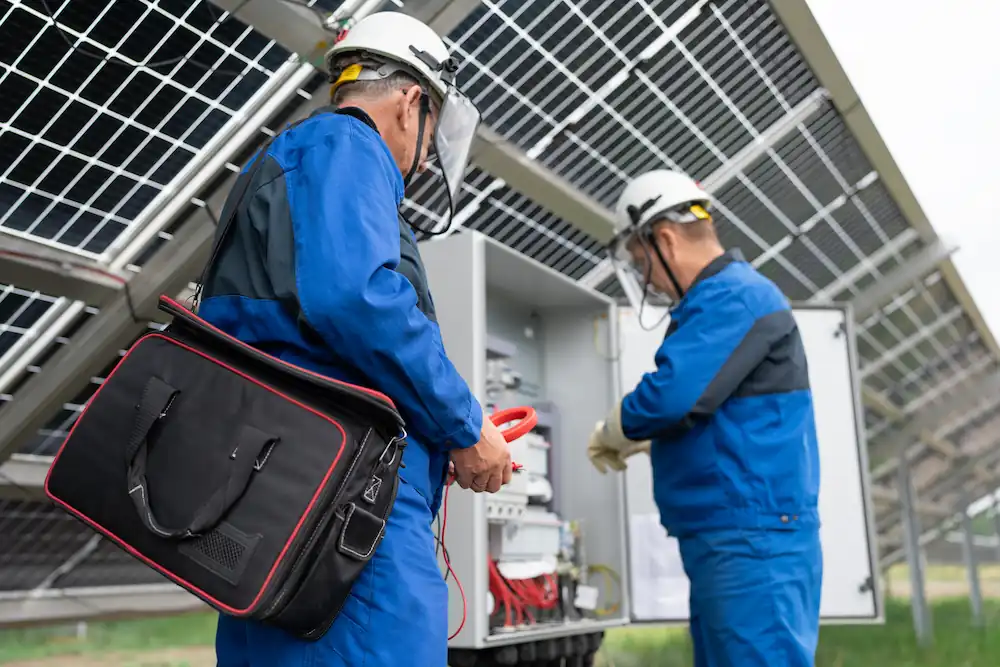
PV battery maintenance to avoid performance drops and failures in the storage system
Photovoltaic battery that lasts less or discharges quickly
When a PV battery begins to lose range or discharges faster than expected, the problem affects not only the component, but the entire balance of the storage system. The drop in performance can occur gradually, with a reduction in available energy, or more noticeably, with irregular charge and discharge cycles.
In many cases these signals are underestimated, especially in the early stages. However, a change in battery behavior indicates that something in the system is no longer aligned: environmental conditions, mode of use, or interaction with the inverter can directly affect overall performance.
Maintenance of photovoltaic batteries arises from this very need: to monitor performance, detect anomalies, and maintain stable operation of the storage system over time.
When a storage battery starts to lose efficiency
A battery does not suddenly lose efficiency; in most cases progressive signs emerge that, if read correctly, allow action to be taken before the problem becomes more complex.
The most frequent situations include faster discharges, inconsistent charging times, or a reduction in available range in the evening hours.
These elements indicate a variation in the behavior of the storage system, which may depend on multiple factors.
The first concerns how the battery is used. Unbalanced charge and discharge cycles or heavy use affect capacity over time.
The second concerns the installation environment: high temperature or unstable conditions directly affect performance.
Finally, a central role is played by the connection with the inverter, which regulates energy flows between production, storage, and consumption.
When these elements are not aligned, the battery fails to work under optimal conditions; therefore, maintenance is not limited to an occasional check, but involves continuous verification of system performance and behavior.
How to protect photovoltaic storage batteries over time
Protecting a storage battery will allow it to maintain stable operating conditions over time; it does not require invasive interventions, but constant attention to factors that directly affect durability.
- The first element to control is temperature: batteries work most efficiently within well-defined ranges, while conditions that are too high or too low accelerate degradation.
- A second aspect concerns charge and discharge cycles: balanced use preserves battery capacity, while frequent deep discharges or incomplete recharges can reduce battery life.
- The environment in which the system is installed also plays an important role. Humidity, ventilation and stable conditions affect the overall behavior of the storage.
- Finally, data monitoring enables the identification of abnormal variations and intervention before they result in loss of performance.
In this sense, battery protection is a set of controls that keep the relationship between production, storage, and energy consumption consistent.
Battery types and differences in storage system maintenance
Not all batteries require the same level of attention; differences between technologies directly affect how they are managed and what controls are needed over time.
Lithium batteries are the most popular in storage systems today because they offer more stable management and require limited direct intervention. This does not mean no maintenance, but greater integration with control and monitoring systems.
Lead-acid batteries, on the other hand, have more specific requirements and may require more frequent checks, especially in relation to the conditions of use and the environment.
When referring to “maintenance-free” batteries, the reference is to the absence of direct manual intervention. However, even in these cases, monitoring the performance and behavior of the system remains essential, because any anomalies will still emerge over time.
Thus, the choice of technology affects not only the storage capacity, but also how the battery must be managed to maintain consistent performance.
What to check in a photovoltaic battery
Effective control starts with the behavior of the entire storage system, not individual isolated elements. The battery maintains stable performance when it works consistently with production, consumption, and energy management of the system.
The first aspects to observe concern charging and discharging: erratic cycle patterns or differences between energy produced and stored indicate an imbalance that can affect overall performance over time. In parallel, the role of the inverter is central: it regulates energy flows and directly affects the quality of charging.
Monitoring data also offer useful indications: deviations from usual values, sudden changes, or system alerts indicate suboptimal operating conditions. Reading these signals allows action to be taken before the problem spreads.
Finally, the context in which the system operates has a direct impact.
Temperature, ventilation and stability of the environment affect the behavior of the battery and its continuity over time.
Control, then, is about the relationship between storage, energy management, and operating conditions, keeping the whole system consistent during use.
Errors that reduce the life and efficiency of photovoltaic batteries
Performance losses do not always result from obvious failures; they often develop gradually through conditions that reduce battery capacity over time.
One of the most common errors involves failure to pay attention to initial signals.
Reduced autonomy or uneven cycling already indicate a change in system behavior. If overlooked, these signals lead to more complex interventions.
Another critical element concerns the installation environment:inadequate temperatures or insufficient ventilation directly affect performance and accelerate degradation.
Usage also affects over time. Unbalanced managed charge and discharge cycles can reduce available capacity and compromise system stability.
- Absence of constant monitoring of performance
- Unsuitable environmental conditions for the storage system
- Unbalanced management of charge and discharge cycles
- Anomalies not considered in the early stages
Common problems of photovoltaic batteries and what they indicate
When a storage battery is not working smoothly, the system tends to exhibit recognizable signals. These signals should not be interpreted as isolated faults, but as indicators of behavior that is deviating from the expected conditions.
One of the most frequent cases involves a faster-than-expected discharge. In these situations, the battery loses autonomy during the hours when it should be sustaining consumption, with less energy available than in normal use. This can be related to a reduction in capacity over time, unbalanced usage cycles, or unstable operating conditions.
Another recurring scenario occurs when the inverter does not charge the battery properly. Here the problem is not just with the battery, but with the way the system manages the energy flow between generation and storage. The cause may be misaligned configurations, malfunctions in operation, or conditions that limit charging.
Then, situations are observed in which the available capacity is lower than expected. This behavior manifests itself with reduced autonomy even in the presence of adequate energy production. In these cases, it is necessary to evaluate the evolution of performance over time and the way the system is used.
These signals should always be read in relation to the operational context. An isolated variation may not have an immediate impact, while a condition that is repeated over time indicates the need for a more thorough review.
- Rapid discharge: possible reduction in capacity or unbalanced use
- Incomplete recharge: anomaly in energy flow management
- Reduced autonomy: variation in performance over time
- Irregular behavior: unstable operating conditions
How long does a storage battery last and what affects its life
The lifetime of a photovoltaic battery does not depend on one factor alone, but on the set of conditions under which it is used. Popular technologies, such as lithium-ion batteries, maintain high performance for several years, but their capacity varies with use and operating context.
One of the most relevant elements concerns charge and discharge cycles; in fact, balanced use preserves capacity over time, while frequent and deep cycles tend to reduce available energy more rapidly.
Temperature also has a direct impact. Inadequate conditions accelerate degradation and affect the stability of performance, and this is compounded by the quality of monitoring: a continuously monitored system makes it possible to detect variations and maintain more stable conditions.
When we talk about durability, therefore, we are not just referring to years of operation, but to the battery’s ability to maintain a consistent level of performance over time. Careful management allows this phase to be prolonged, reducing the risk of sudden drops.
When maintenance affects the whole photovoltaic system
The storage battery works together with the system, not separately. Its behavior depends on how production, consumption, and energy management remain aligned over time.
When the production drops, the battery receives less energy and the available range is reduced; this happens during periods of lower irradiation or less favorable days, without there necessarily being any technical anomalies.
The critical point is the balance of the system. If production, storage, and consumption are not consistent with each other, uneven performance may emerge even with functioning components.
- Production not aligned with consumption
- Accumulation not properly exploited
- Non-optimized energy management
Therefore, control must extend to the entire plant.
PV battery maintenance and continuity of performance over time
Maintenance is about control and the ability to keep the system stable over time, as a battery works well when operating conditions remain consistent.
Some elements require constant attention:
- regularity of charge and discharge cycles
- monitoring data and changes over time
- environmental conditions
- plant behavior
When these factors are under control, performance remains more stable and stored energy is managed efficiently.
On the other hand, if repeated signals appear, action must be taken. A technical check can identify the cause and return the system to proper operating condition.
If you want to understand how your storage system is working, ask us for a direct comparison.